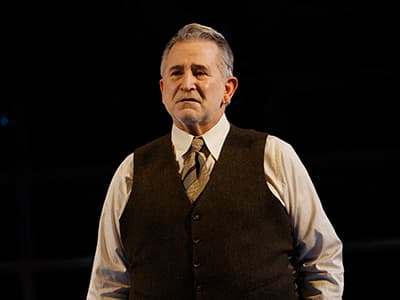
Anthony LaPaglia delivers a remarkable, deeply unsettling performance as Willy Loman in Neil Armfield's powerful revival of Arthur Miller's Death of a Salesman.
Some plays you admire from a distance; others get under your skin and linger long after you've left the theatre. Death of a Salesman is one of those rare, haunting works.
Written in 1949, Miller's tragedy of an ageing salesman and his family has been revived so often that it often arrives burdened by the weight of its reputation. We know Willy. We know Biff. We know the debates about the American Dream. The challenge is making an audience care about them all over again.
This production succeeds.
At its centre is LaPaglia's Willy Loman. A travelling salesman, though Miller never tells us exactly what he sells, Willy has spent a lifetime believing that hard work, being well liked, and knowing the right people will eventually pay off. He has passed those beliefs on to his sons. The trouble is, the world has moved on, but Willy has not.
LaPaglia is superb because he refuses to make Willy easy to like. There are moments when you want to shake him. He boasts, bullies, lies, exaggerates, and can be vain and unreasonable. Yet LaPaglia never lets the bluster define the entire man.
Make Willy too pathetic, and the character turns sentimental; make him too unpleasant, and the audience stops caring. LaPaglia finds the man in between, someone who has spent so long constructing an image of himself as a successful salesman, admired figure, and proud father that he now seems terrified there may be very little left underneath.
Miller's genius lies in showing that what destroys Willy is nothing extraordinary. It is a house, a car, a job, bills, a failed maths examination, his sons, the expectations he has placed upon them, and the growing suspicion that he may have spent his entire life chasing the wrong things.
There is no single villain, only the accumulation of ordinary disappointments that eventually becomes unbearable.
The emotional heart of the production is the relationship between Willy and Biff. Josh Helman's Biff is, in equal measure, angry, frustrated, and vulnerable. Once the golden boy who seemed destined to become everything his father wanted, he has become the living contradiction of Willy's dreams.
After failing his maths examination, Biff travels to Boston hoping his father will help him. Instead, he discovers Willy's affair, destroying something between them that neither can repair. Biff begins to see not only his father differently, but also the entire story Willy has constructed about success.
Willy needs Biff to succeed because that success would prove his own sacrifices meant something. Biff simply wants his father to accept the man he actually is.
They love each other very much. They just don't love each other very well.
That simple truth is what makes Death of a Salesman so devastating. The American Dream may be part of Miller's subject, but the play hurts most when the big idea collapses into a family argument.
Biff wants to go west. He wants to work on a farm. He does not want the office, the business career, or the conventional success his father has spent his life imagining for him. He has made mistakes and disappointed people, but he is beginning to realise there may be nothing wrong with an ordinary life.
The danger is pretending to be somebody else.
Ben O'Toole's glorious portrayal of Happy Loman offers another variation on the same theme. He appears to have everything Willy values: a job, women, confidence, and the outward signs of having made something of himself. Yet there is something desperately sad underneath. He has inherited more of Willy's illusions and fewer of Biff's doubts. He may be doing better than his brother, or he may simply be better at fooling himself.
And then there is Linda.
Alison Whyte is magnificent.
Linda can easily be reduced to the long-suffering wife who patiently puts up with Willy. Whyte finds something far more complicated. She sees what is happening. She knows Willy is failing, that Biff is unhappy, that the family is coming apart, and that her husband is frightened. So, she looks after him, not because he is a great man, and not because she fails to see his faults, but because she loves him.
As Charley (Marco Chiappi) observes: "A small man can be just as exhausted as a great man."
That simple truth clears away the noise of ambition and leads directly into Linda's devastating plea that "attention must be paid". She is not asking us to pretend Willy has been successful. She is asking us not to dismiss a human life simply because it has not achieved greatness.
Whyte gives Linda both dignity and steel. She is the person holding the family upright for as long as she can, and when she finally cannot, the effect is devastating.
The supporting cast brings the wider world of the Loman family into focus, with Anthony Phelan as Uncle Ben, Paula Arundell as The Woman, James Smith as Bernard, Elizabeth Blackmore as Miss Forsythe, alongside Adelaide performers Mark Saturno as Howard and Luca Sardelis as Jenny.
The scene with Howard remains particularly brutal. Willy approaches his employer believing that years of loyalty should count for something. He does not want charity; he merely wants a position in New York so he no longer has to travel. Howard, meanwhile, is more interested in his new recording machine and barely listens.
It becomes a stark realisation of the play's most cutting warning: "You can't eat the orange and throw the peel away. A man is not a piece of fruit."
Willy still believes a working relationship involves some kind of human obligation. Howard does not. Once again, he discovers that the rules he has built his life around are not necessarily the rules by which the world operates.
Armfield's production places the Lomans within a distinctive physical world. Dale Ferguson's design uses the bleachers of Ebbets Field as its setting, connecting Willy's dreams of success to a place that has itself become a monument to a vanished world. The choice gives the production a visual sense of memory, ambition, and decline rather than presenting a conventional domestic interior.
Willy's memories do not arrive politely when summoned. They simply appear. The football victories of Biff's youth have become almost mythical in his father's mind, while the failed maths examination remains painfully present decades later. Conversations from years ago occupy the same space as the present. At times it is difficult to tell whether we are watching memory, dream, or reality.
Increasingly, Willy cannot tell either.
The tragedy of Willy Loman is that he spends his life selling things to other people. In the end, the person he has persuaded most successfully is himself. He has convinced himself that being well liked is the same thing as being successful, that Biff must succeed for his own life to have meaning, and that the next opportunity will somehow make everything right.
Yet there are things he cannot see clearly enough: Linda loves him, his sons love him even when they are angry with him, and Charley, despite everything, tries to help him.
Being loved is not the same thing as being successful.
The world has changed enormously since 1949, but the fear underneath Willy's story remains recognisable: the fear of becoming irrelevant, the fear that your children will not become what you imagined, the fear that your work has not delivered what you thought it would, and the quiet suspicion that you may have spent years trying to become somebody you were never meant to be.
What makes this production particularly affecting is that it never reduces Willy to an idea. He is not simply "the American Dream". He is a husband, a father, a salesman, a man getting older, a man who has made mistakes, a man who has hurt people and been hurt himself.
Above all, he is a man who wants his life to have mattered.
Watching it made me think about family, ambition, and some of the things we have believed about life over the years. That is what great theatre does. It takes somebody else's story and, somehow, makes you examine your own.
Miller’s work is a complex and thought-provoking exploration of ambition, disillusionment, and the fragile nature of identity. It is an unsettling play, confronting the darker sides of the human experience – regret, disappointment, and the longing for significance – that many might prefer to ignore. Yet, as the work of a master playwright, it remains essential viewing for its insight, emotional power, and enduring resonance.
Event details
GWB Entertainment in association with Adelaide Festival Centre presents
Death of a Salesman
by Arthur Miller
Director Neil Armfield
Venue: Festival Theatre | Adelaide Festival Centre SA
Dates: 26 September – 4 October 2026
Bookings: adelaidefestivalcentre.com.au